
In 2025, Americans held over $81 trillion in stocks, bonds, mutual funds, pension funds, and insurance funds—nearly all of it invested in global corporations. Little of this money benefits local and regional economies. But there is an alternative. You can invest in local people, projects, and businesses instead.
Why bother? Here are six reasons:
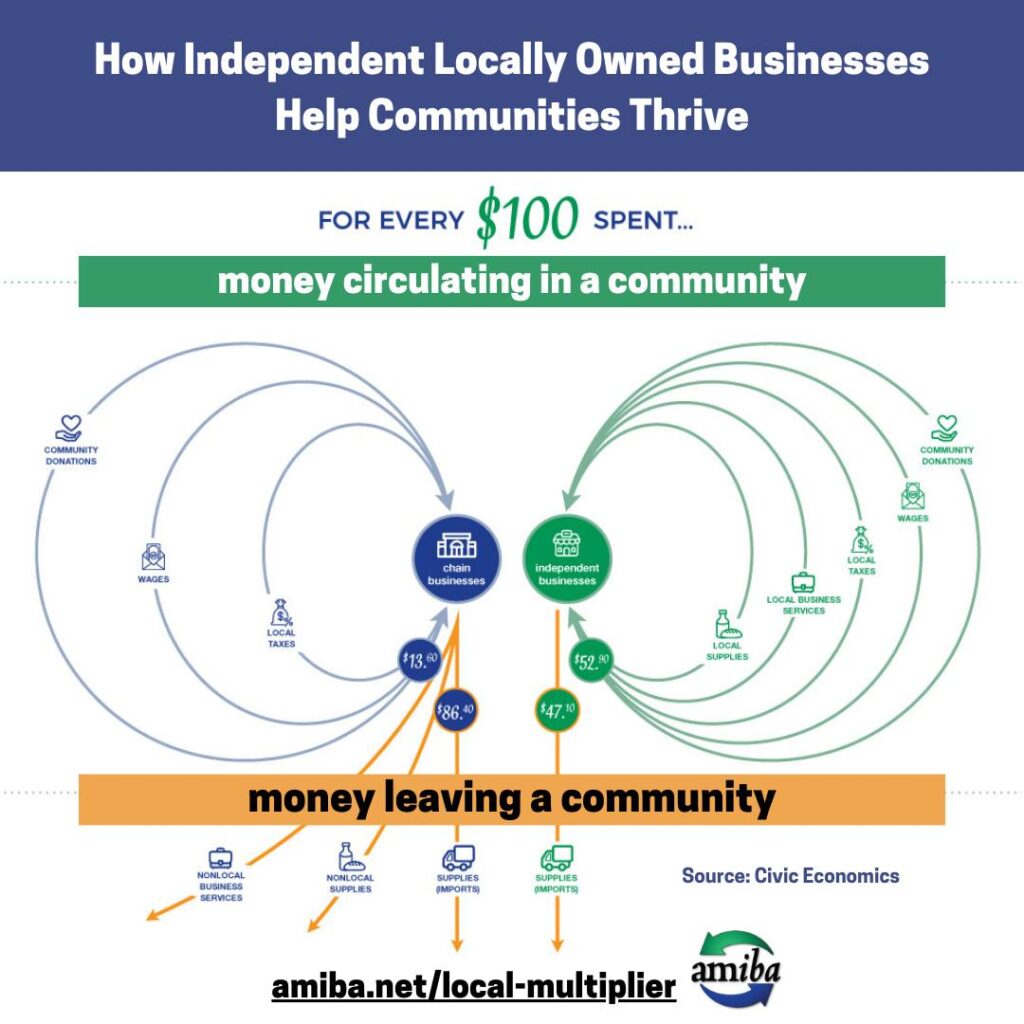
1. It’s good for your community. If residents shifted just a portion of their savings from Wall Street to Main Street, there would be billions of dollars available for affordable housing, energy efficiency businesses, and myriad other local priorities. It’s hard to imagine any economic development initiative that could have nearly this kind of impact on a region.
2. It’s good for social justice. A study by the Federal Reserve in Atlanta showed that in those counties with the highest density of thriving local businesses, there was the highest per capita income growth rate. Investing locally means bringing down poverty and improving social equality locally.
3. It’s easy to do. Since the legalization of investment crowdfunding in 2016, Crowdfund Advisers reports that about 6,500 local companies in the U.S. have raised $2.48 billion from over 2 million Americans. The options for local investment are expanding every day and now include local cooperatives, nonprofits, real estate projects, municipal bonds, and local investment funds.
4. It’s good for your wallet. With smart shopping, you can find investments that match or exceed Wall Street returns. If you invest in yourself, your family, or your friends—which is another form of local investment—you can enjoy potentially huge rates of return. Every dollar invested in paying off your (or someone else’s) credit card debt, for example, generates a 25-30% rate of return in avoided interest. Putting solar on your roof creates a great rate of return, especially because you qualify for IRA tax credits.
5. It’s lower risk. People assume that investing locally means investing in risky business startups. You can do that, but a risk-averse local investor can focus on existing businesses—and ground the business or project before you put a penny into it. This explains why the default rates for local banks, which rely on long-term relationships for lending decisions, are lower than those for big banks, which rely on computerized credit scores.
6. It’s doable with tax-deferred money. Most people have 401(k) or IRA plans that provide no local investment options. Zip. But with a little work, you can move your money into a solo 401(k) or self-directed IRA that enables you to invest in all the options mentioned above.
Want to connect more with the local investment movement? Subscribe to The Main Street Journal today!
Michael H. Shuman is an economist, attorney, and author of ten books, including, most recently, “Put Your Money Where Your Life Is.” He also teaches in Bard’s Green MBA Program.